

All captions written by Dane Steadman
When we first heard the sound, we weren’t surprised: a crack that split the night air, followed by a growing roar. Just another avalanche off the immense seracs that hung over the northeast face to our left, we thought. August Franzen, Cody Winckler and I were snuggled up in our three-person sleeping bag, enveloped by the green walls of our little tent perched on a blade of snow 4,265 feet up our first Karakoram wall. It had been 18 years since a climbing team had visited this remote valley in far northern Pakistan, and the austere north wall of Yashkuk Sar I (21,870 feet), towering 6,562 feet above the Yashkuk Yaz Glacier, remained unclimbed.
The trip was filled with uncertainty from the start, but over the previous year of poring over Google Earth imagery and what few photos we could track down, one unknown had risen to the top: the shadowy, nearly 1,000-foot headwall that guarded the summit. Big avalanches weren’t a surprise. We’d seen one already while on the route, and many before that in the weeks acclimatising, but always from the seracs on either side of the central pillar. We knew our line was safe from the serac avalanches, so we almost didn’t bother to look.
August Franzen (left) and Cody traverse the top of the headwall on the north pillar of Yashkuk Sar I. After four days of climbing on shattered, black gneiss between ice runnels, the band of compact, creamy marble right below the summit made for a memorable finish. Photo: Dane Steadman.

But when Cody unzipped the tent door, we were horrified to see the avalanche roaring down the headwall’s central weakness in the silvery moonlight, just left of our perch. We’d been so focused on the seracs that we hadn’t thought much about the gargantuan snow mushrooms plastered to the headwall itself, like the one that had just released and was currently charging directly down the system we planned to climb the next day. I felt sick to my stomach as I imagined thousands of pounds of dense snow, peppered with ice chunks and pieces of shattered black gneiss, crashing down on our heads and sweeping us to the glacier below. The consequences of a wrong move in this game we played were suddenly all too clear.
The story unfolded at this bivouac. Dane Steadman contemplates the team’s airy second bivy before tucking in for the night. Photo: August Franzen

“Well … what do you guys think?” I asked into the gloom. Silence. After a year of dreaming and days of navigating the chaos of the serac-crowned wall, the mood was tense. We all wanted this climb more than we’d ever wanted one before. For me, at least, it was the culmination of all the dreams that had started my climbing journey: a beautiful, technical route on an unclimbed peak in a minimally explored valley set among the greatest mountains on Earth, the ones that had captivated my imagination from the beginning. It was hard to imagine having another opportunity like this anytime soon. But the stillness of the night air confirmed the mountain’s indifference. If we played our cards wrong, it could extinguish us in an instant. I knew then that I wouldn’t enter that central weakness, but I wasn’t ready to give up hope quite yet.
Still in silence, I pulled out my phone and began frantically studying photos of the headwall, including a close-up Cody had fortuitously taken when he arrived at the bivy before the light faded. As I sat hunched in the back corner of the tent, scrolling back and forth and zooming in and out, things looked less and less probable: The central weakness seemed to be the only feasible line. The one obvious way to avoid exposure to the dozens of mushrooms that clung menacingly to the wall, the series of monolithic black towers that bounded the right edge of the headwall, simply looked too hard.
August Franzen (left) and Cody traverse the top of the headwall on the north pillar of Yashkuk Sar I. After four days of climbing on shattered, black gneiss between ice runnels, the band of compact, creamy marble right below the summit made for a memorable finish. Photo: Dane Steadman.

With the cloud-veiled summit of Yashkuk Sar I peeking up in the background, August moves through an icefall on the team’s final acclimatisation excursion. On this outing, the team made the likely second ascent of Sakar Sar (~20,600 feet) via a new route spiraling around the mountain, from south to west to northeast. Photo: Cody Winckler
But then I saw something that might work. “There might be a way up the left side of the headwall,” I said from my corner. August and Cody followed along on the photo as I talked it through. “After we rappel off this ridge in the morning, we can follow the snowy spine between the ice gullies up to the headwall.”
“Yup,” Cody chimed in, “if any mushrooms come off they’ll fall to either side of us there.”
“Exactly,” I said. “Once we reach the headwall, it looks like there might be a tiny dribble of ice left of the central weakness, then there seems to be some sort of gash through that steep band,” I turned my screen toward them and pointed. “That would get us to the left edge of the headwall, where we’ll be totally safe from mushrooms. Hopefully there’s a good bivy there,” I went on, unable to keep excitement from creeping back into my voice. “Then we just have to follow the crest for a ways until we get to that forest of mushrooms, then weave back right through those until we’re off the headwall!”
Cody starts up what turned out to be the crux pitch of the route on the fourth day on Yashkuk. The crux involved hooking semi-frozen blocks of gneiss up a gently overhung snow-plastered wall around the corner to the right. Photo: August Franzen

“Damn,” August replied, a bit more somberly. “That looks pretty wild. But it might just work.”
“And it looks like it’ll keep us pretty safe from the mushrooms,” Cody said. “I think it’s worth a shot.”
And so we decided: Our climb wasn’t over yet. We knew the higher we climbed, the more committed to the line we would feel, as our easiest way down would be over the summit. But the new line appeared safe, the weather was holding and our belief in ourselves, while rattled, remained intact. I lay back down and closed my eyes. And while the nausea in my stomach remained, I felt hope blossom beside it.
Left: Cody and August (with the red pack) bask in the sunlight after exiting the cold shadow of the north pillar onto the summit ridge, on the evening of the fourth day. Photo: Dane Steadman
Right: The left photo, as seen from Cody’s perspective. Dane leads toward the summit shortly before the team’s fourth and final bivy. Photo: Cody Winckler

Three days later, on the evening of September 23, 2024, we coiled our ropes on the rocky, dry glacier beneath the most meaningful climb of our lives thus far. We called the route Tiger Lily Buttress.
A topo of Tiger Lily Buttress, drawn by Dane after the team returned to base camp at Pomeri on September 24, 2024.


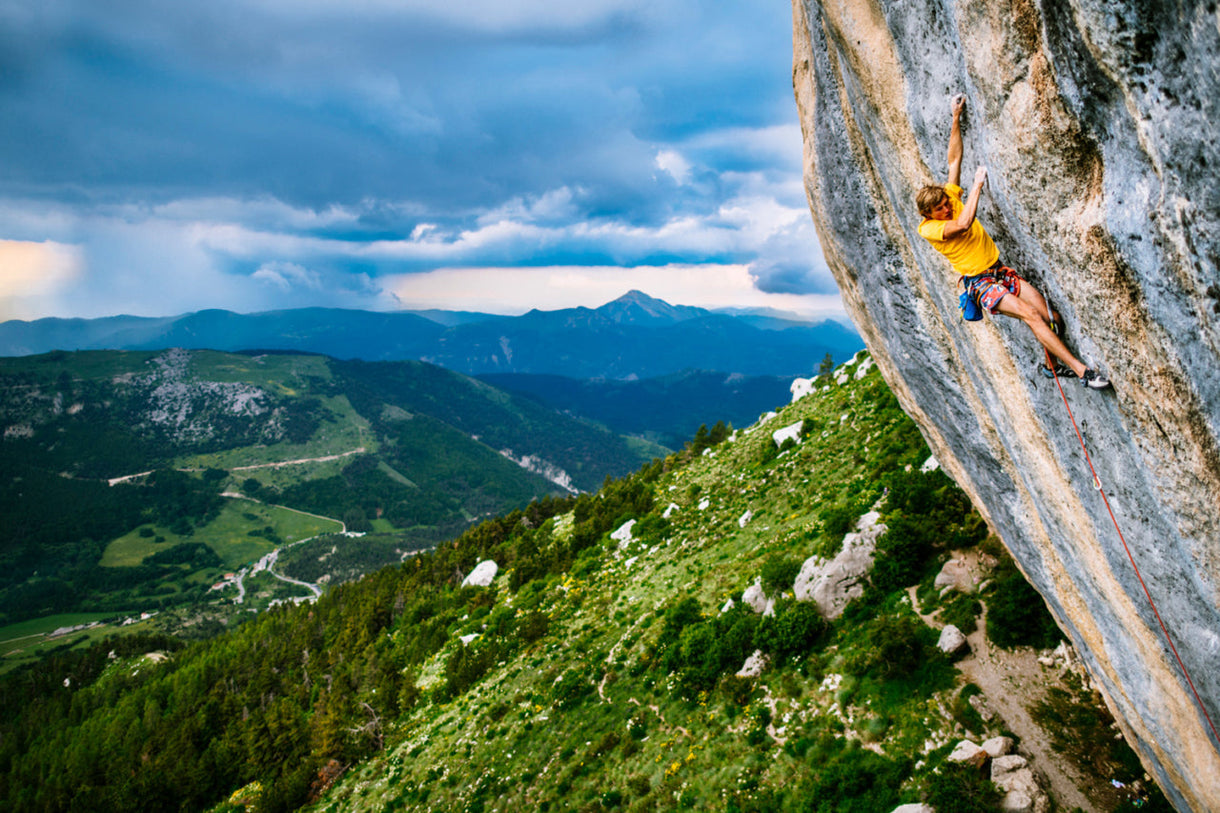










Dane lives in Cody, Wyoming, where he works as a guide and spends his free days exploring the Greater Yellowstone Ecosystem. He joined Patagonia as a Climb ambassador in 2025.